I Am You, 2024
An interactive audio-visual installation that explores interaction between humans and a (intelligent) system and questions what happens when interaction itself becomes the system through which reality is constructed.
Synopsis
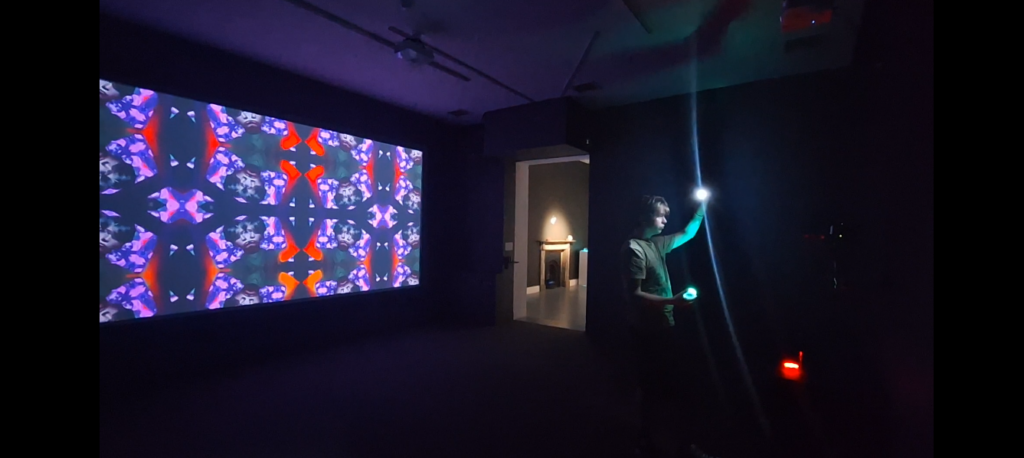
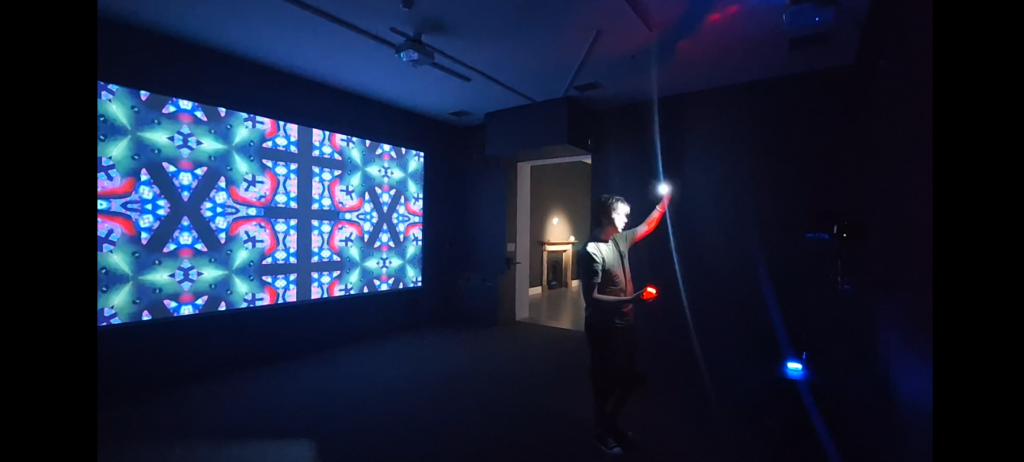
Upon entering the space, visitors encounter a large-scale kaleidoscopic projection generated in real time from their own image. As participants move, a camera continuously captures their presence, transforming fragments of their bodies into evolving symmetrical compositions. Simultaneously, an AI-generated soundscape analyses the evolving image and responds by composing an ever-changing sonic environment.
Rather than functioning as separate elements, participant, camera, algorithm, image, and sound form a continuous interactive loop in which each influences the next. Every movement becomes an act of interaction and communication. The participant sends visual information to the system, which interprets, transforms, and returns it as a new visual language.
The installation invites visitors to experience communication not as the exchange of messages but as an ongoing interactive process through which meaning, identity, and relationships are continually negotiated.
Narrative
Contemporary life is increasingly shaped by interactions with systems that observe, interpret, predict, and respond to human behaviour. From algorithms and artificial intelligence to institutions and digital platforms, communication is no longer limited to conversations between people. We now communicate continuously with systems that simultaneously communicate back to us.
I Am You investigates this emerging relationship.
Inspired by theories of language, communication, cybernetics, and interactive systems, the installation proposes that reality is not simply represented through technology but actively constructed through interaction. Meaning does not exist before interaction; it emerges through it.
The kaleidoscope becomes more than a visual metaphor. It functions as a communication system. Every image originates from the participant, yet the algorithm reorganises that information according to its own internal logic. The participant recognises aspects of themselves while simultaneously encountering something unfamiliar—a visual response shaped by continuous negotiation between human intention and machine interpretation.
Artificial intelligence extends this dialogue into sound. Rather than illustrating the visuals, the AI interprets movement, rhythm, colour, and complexity, generating an evolving composition that becomes another participant in the conversation. Vision, sound, body, and algorithm continuously influence one another, creating a living feedback system in which authorship becomes distributed rather than individual.
The installation therefore shifts attention away from representation and towards communication itself. Identity is not presented as fixed or essential but as something continually produced through interaction. Every gesture changes the system. Every response changes the participant. Human and machine become co-authors of a shared communicative environment.
The title I Am You reflects this reciprocal relationship. It suggests that communication is never a one-way process. We shape the systems we create, but those systems simultaneously shape how we perceive ourselves, how we understand others, and how we negotiate our place within an increasingly mediated world.
Technical
The installation consists of a computer running TouchDesigner, a digital camera, a video projector, a projection surface, an audio system, and the necessary signal distribution hardware to connect all devices.