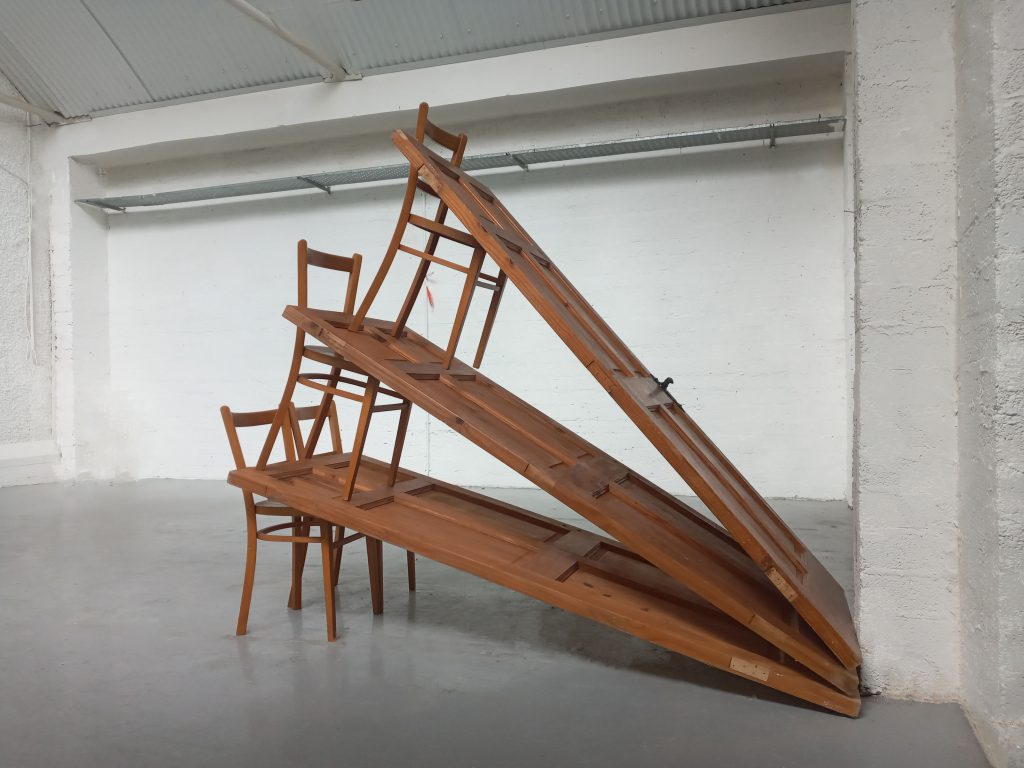
Stairways to Heaven visualises the feeling of overcoming one systemic or legal barrier only to immediately face another identical wall.
Synopsis
The sculpture is constructed inside an open, white industrial room, using raw, structural materials arranged to mimic a familiar ascent. It expands on my practice of using altered, unglamorous domestic objects to trace the complex psychology of displacement, migration and systems.
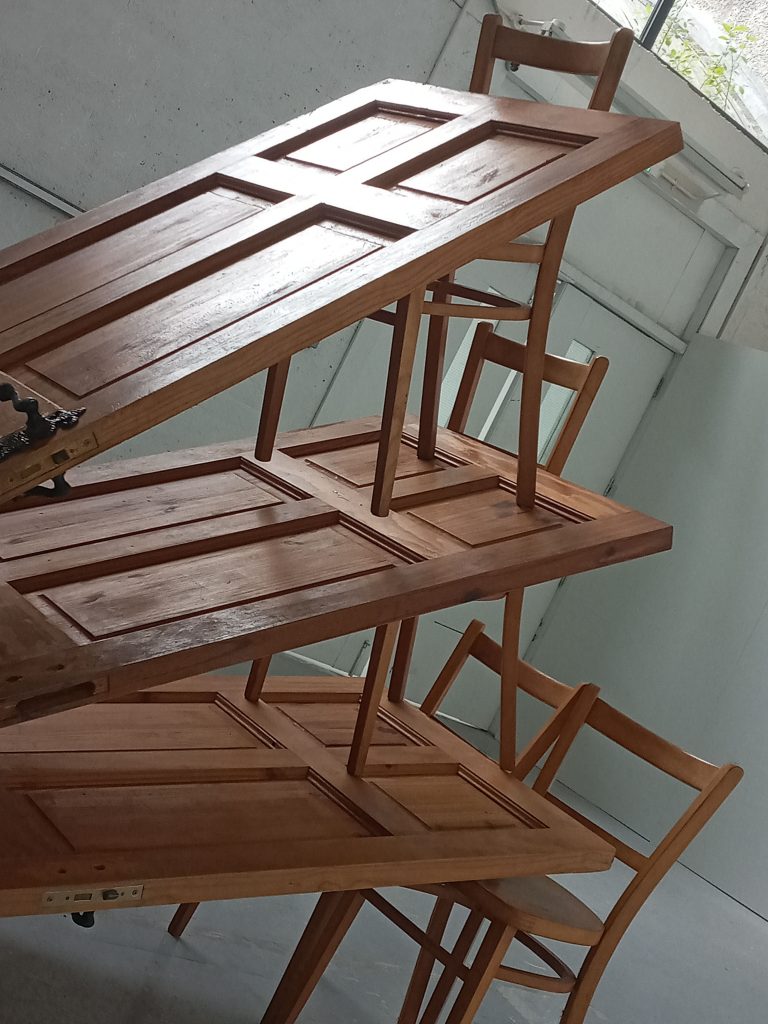
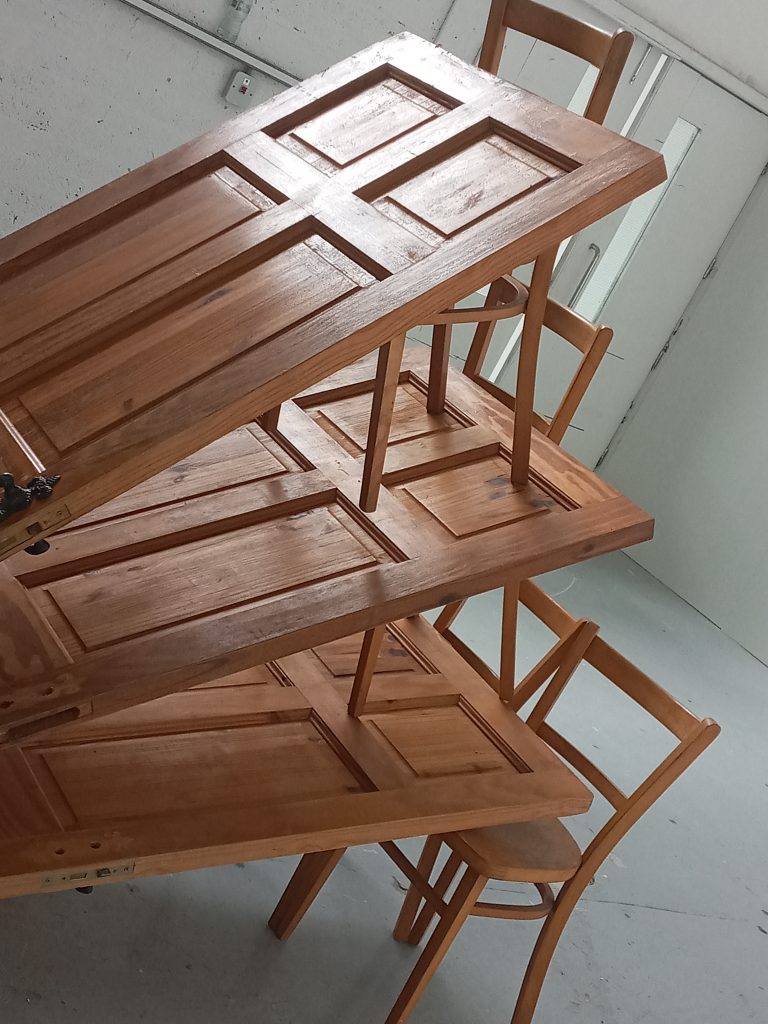
Rather than functioning as entryways, three massive timber doors are stacked on top of one another at a sharp diagonal angle. They lean heavily against a stark supporting pillar, forming a precarious, improvised ramp. Four ordinary dining chairs are integrated into the incline. The sequence begins with one chair placed firmly on the concrete floor, while the remaining three ascend the slanted surface, anchored directly onto the panels of the doors.
Narrative
This piece builds upon the narrative vocabulary of his previous works, utilising the same central elements of wooden doors and chairs. However, it shifts the focus toward a monumental, cyclical architecture of hope and systemic obstruction.
Stairway to Heaven subverts domestic safety to make a socio-political statement about the illusion of upward mobility.
The title playfully yet solidly references a climb toward a better life, safety, or prosperity. While the doors and chairs create a literal staircase, the ramp lacks functional steps. It is a steep, slippery incline where the chairs offer no flat place to sit, symbolising the exhausting and unstable nature of trying to “climb” into a new society. Doors normally swing open to welcome transit, but here they are slammed shut and stacked like structural beams. They block horizontal movement, forcing the migrant to look up a path that is precarious and prone to collapse. The manner in which the doors fold over each other suggests an infinite loop. It visualizes the feeling of overcoming one systemic or legal barrier only to immediately face another identical wall. It reflects my ongoing artistic inquiry into why outsiders are often kept perpetually on the margins.